
Magento vs. Shopify 2026: Which E-commerce Platform is Really Right For You
Magento vs. Shopify 2026: A Candid Comparison of Real Costs, TCO, GDPR & B2B in DACH – Plus Migration Path.

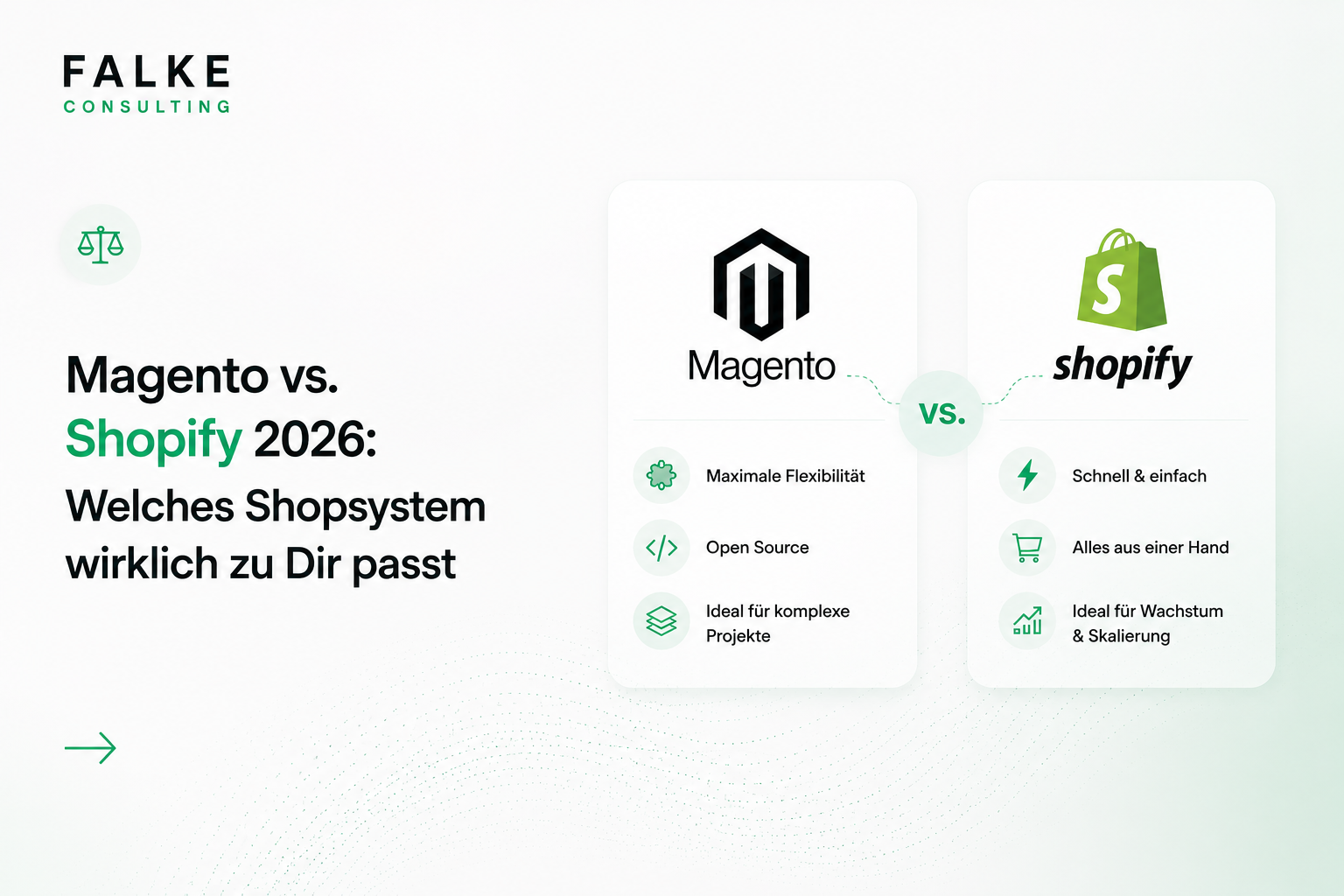
Key Takeaways
- Magento (Adobe Commerce) offers full code control, while Shopify handles hosting, security, and updates.
- Shopify pricing is transparent (starting at €33/month), whereas Adobe Commerce has no public price list and typically starts in the five-figure annual range.
- For small to medium-sized stores, Shopify generally offers a more cost-effective and predictable Total Cost of Ownership.
- Both are enterprise-ready; the difference lies in the required effort, not in their capability.
Magento (now Adobe Commerce) and Shopify tackle the same task in opposing ways. Magento gives you control over every line of code. Shopify takes care of hosting, security, and updates for you. Most comparisons stop at a feature table. We go further: real total costs instead of attractive list prices, GDPR and VAT in the DACH region, the B2B reality, and a chapter on what simply doesn't work with either system.
01Magento & Shopify – Two Philosophies
Magento is a PHP-based open-source platform that has belonged to Adobe since 2018 and is continued there as Adobe Commerce. The idea: You get the full source code and build your store yourself down to the smallest detail – multi-store, complex product logic, custom checkout flows. Pure freedom, but every freedom is also a responsibility.
Shopify takes the opposite approach. It is a cloud-based SaaS platform that you use on a subscription basis: Hosting, security, updates, and PCI compliance are built in. You sell via online store, POS, marketplaces, and social channels – centrally managed in the admin. Instead of "build everything yourself," the motto here is "start immediately, expand via apps."
Almost every difference hinges on this one fundamental decision – control versus relief. It is also evident in the market: According to BuiltWith, over five million active stores worldwide run on Shopify. Magento and Adobe Commerce combined are in the low six-figure range, a trend that has been stagnant for years.
"The question is rarely 'Which system can do more?' – Magento can almost always do more. The question is: 'Which effort pays off for exactly your store?'"
02Cost Comparison: What You Really Pay
When it comes to money, the systems diverge immediately. Shopify states its prices openly, Magento does not. Magento Open Source is license-free – but you pay for hosting, maintenance, security, and compliance yourself. Adobe Commerce, the Enterprise Edition, has no public price list at all: The license is calculated individually based on revenue and is, from experience, in the low to mid five-figure range per year, not including development and operation. The full Shopify overview is provided in the article on Shopify Costs 2026.
Shopify presents its tariffs openly (as of 2026, net prices plus VAT, up to 25% cheaper with annual payment):
| Shopify Plan | Price / Month | Suitable for |
|---|---|---|
| Basic | €33 (€25 annually) | Founders & small teams, quick start |
| Grow | €88 (€66 annually) | Growing stores from ~€15,000 monthly revenue |
| Advanced | €384 (€289 annually) | Established merchants, international |
| Plus | from ~€2,100 (annual/3-year contract) | Brands with native B2B & Enterprise needs |
Important: Shopify bills in US dollars; the Euro prices are indicative. Transaction fees (with Shopify Payments online approx. 2.1% + €0.30 in Basic up to 1.3% in Plus) and app costs are additional. The real total costs are usually two to three times the pure subscription fee – more on this in the next chapter.
03Total Cost of Ownership – The Hidden Costs
The subscription price says little about your actual expenses. What is crucial is the Total Cost of Ownership – everything that accumulates over months and years. And this is precisely where Magento's "free" open-source variant often becomes more expensive than expected.
| Cost Block | Magento | Shopify |
|---|---|---|
| Hosting & Operation | Server, tuning, backups – your responsibility | Completely included, scales automatically |
| Development | Usually dev team or agency retainer | Much without code, specialized themes selectively |
| Updates & Security | Patches & version migrations yourself | Runs centrally in the background |
In practice, with Shopify, the subscription fee is the largest predictable fixed cost, plus variable transaction and app costs. With Magento, the license is often the smallest component. Hosting, development, and maintenance make up the bulk and are harder to predict. For most small and medium-sized merchants in the DACH region, this calculation precisely tips the scales.
04Operation, Maintenance & Updates in Daily Business
An online store system does not live from its launch, but from its day-to-day operations. With Shopify, your team can independently edit content, products, and layout in the admin – without any technical experience. Thanks to Online Store 2.0, you work with sections, metafields, and app blocks, control layout and content without code, and remain update-safe.
Magento, especially in the open-source variant, requires significantly more technical setup and ongoing support. In return, you get full control over the stack, hosting, and code. The most important difference in daily use: With Shopify, there are no "major update" migrations. Updates run centrally, without you having to manually upgrade a version. Magento/Adobe Commerce occasionally requires complex version migrations – a project that ties up time and budget.
For teams with strong internal dev power, Magento's control can pay off. For most stores, however, the time/cost-benefit ratio has been decided in favor of Shopify – simply because there is less friction in operation.
05Themes, Personalization & Extensions
The topic of extensibility particularly highlights the difference between "open" and "curated." Both have large ecosystems – but with different quality control.
Magento Marketplace: Over 4,000 extensions, maximum depth – but in practice, compatibility issues arise: Not every module is maintained in a timely manner for new versions, and plugins can interfere with each other. Outdated extensions quickly become a security or performance risk.
Shopify App Store: Over 8,000 apps, each technically reviewed before publication. Particularly tightly integrated solutions bear the "Built for Shopify" badge. App blocks integrate seamlessly into the frontend – install instead of program (see best Shopify apps).
In terms of pure design freedom, Magento has the edge thanks to open source: You can delve deep into code and business logic – provided the know-how is available. Shopify counters with a modern theme architecture, dynamic data sources, and reusable templates, with which you can implement content modeling efficiently and without code.
06Security, GDPR & VAT in the DACH Region
In the DACH region, compliance is not a nice-to-have. As a hosted SaaS platform, Shopify fully handles operation and security: PCI-DSS compliance (Level 1), platform security, and ongoing updates are out-of-the-box. With Magento Open Source, you are responsible for security, patches, and compliance yourself – the security level directly depends on your setup.
Neither system comes with "ready-made" GDPR obligations – cookie banners, legal texts, and clean tracking must be added in both worlds (comfortably via apps in Shopify). And when selling across borders, you must correctly state the VAT rates:
| Country | Standard VAT Rate | Reduced Rate |
|---|---|---|
| Germany | 19 % | 7 % |
| Austria | 20 % | 10 / 13 % |
| Switzerland | 8.1 % (since 01.01.2024) | 2.6 % |
Shopify accurately maps these rates via Shopify Tax and Markets; in Magento, you configure tax rules granularly, but manually. More on this in the article about payment providers.
07B2B, Multi-Store & Internationalization
For wholesalers, this often tips the scales. Magento/Adobe Commerce offers advanced B2B and merchandising features at an enterprise level – suitable for complex purchasing structures, self-service processes, and individualized catalogs. Magento is also strong in classic multi-store management via a central admin panel.
On Shopify Plus, B2B functions are natively integrated: company accounts and roles, individual price lists, payment terms, and the option to operate D2C and B2B in a "blended" store or separately. For internationalization, Shopify uses Markets: multiple countries, currencies, and languages from one store – without separate installations.
Both systems are enterprise-ready. Well-known examples: Gymshark scales on Shopify, Helly Hansen long relied on Magento. The difference lies less in the "whether" than in the "how much own effort."
08What DOES NOT work – the honest reality check
With Shopify, you CANNOT:
- Have full access to the platform's source code – Shopify retains it as SaaS. Customizations are done via themes, apps, APIs.
- Make arbitrarily deep checkout interventions beyond Checkout Extensibility (much is intentionally standardized).
- Implement very exotic niche logics without a suitable app – then it becomes custom development.
With Magento, you CANNOT:
- Operate carelessly without technical expertise – without dev power or an agency, it quickly becomes risky.
- Have predictable costs "at the push of a button" – TCO is harder to calculate.
- Perform updates casually – version migrations are real projects.
Both systems demand a trade-off. With Shopify, you give up a piece of control and gain speed and security. With Magento, you accept more effort and gain maximum freedom. Which trade-off is worthwhile depends solely on your store.
09Migration from Magento to Shopify
If the TCO calculation shifts, switching is the logical next step – and cleanly plannable. This is how a professional migration typically proceeds:
- Data Audit: Products, variants, customers, orders, and URLs are recorded and cleaned.
- SEO Safeguarding: 301 redirect mapping protects your rankings – the most common mistake in self-migrations.
- Theme & Setup: New Shopify theme, payment methods, tax rules, and interfaces are configured.
- Test & Go-Live: Staging, QA, then the clean move without data loss and without downtime drama.
With the right partner, this is not a risky project, but routine. We migrate from Magento Open Source and Adobe Commerce to Shopify – and keep data, customer trust, and SEO rankings in mind.
10Conclusion: Which System Suits You?
Magento is better for you if you need to intervene very deeply in code and business logic, want full infrastructure sovereignty, have high internal dev power or a large agency retainer, and consciously accept increased costs for full development freedom.
Shopify is better for you if you want to launch quickly and scale without your own hosting, are looking for an all-in-one solution, need native B2B functions and want to keep complexity lean, value a conversion-strong checkout (including Shop Pay), want your team to manage content & layout themselves, and prefer transparent, predictable costs.
For most merchants in the DACH region, from founders to SMEs to growing brands and many B2B wholesalers, Shopify is currently the more economically prudent choice. Magento plays to its strengths where maximum individualization meets an in-house development department.
Unsure if switching is worth it for you? Schedule an appointment →
Frequently Asked Questions
Is Shopify better for SEO than Magento?
Do I have to migrate to a higher version with Shopify – as with Magento?
Do I have access to the entire code in both systems?
What does Shopify really cost compared to Magento?
Are Shopify and Magento suitable for large online stores?
How complex is the migration from Magento to Shopify?

Seit Jahren setze ich Shopify-Shops für Marken im DACH-Raum um — von der Migration über den Relaunch bis zur Conversion-Optimierung. In diesem Blog teile ich, was in echten Projekten funktioniert.



Mehr aus deinem Shopify-Shop holen?
Lass uns in einem kostenlosen Erstgespräch herausfinden, wo bei dir der größte Hebel liegt — technisch, inhaltlich oder bei der Conversion.
Kostenloses Erstgespräch buchen