
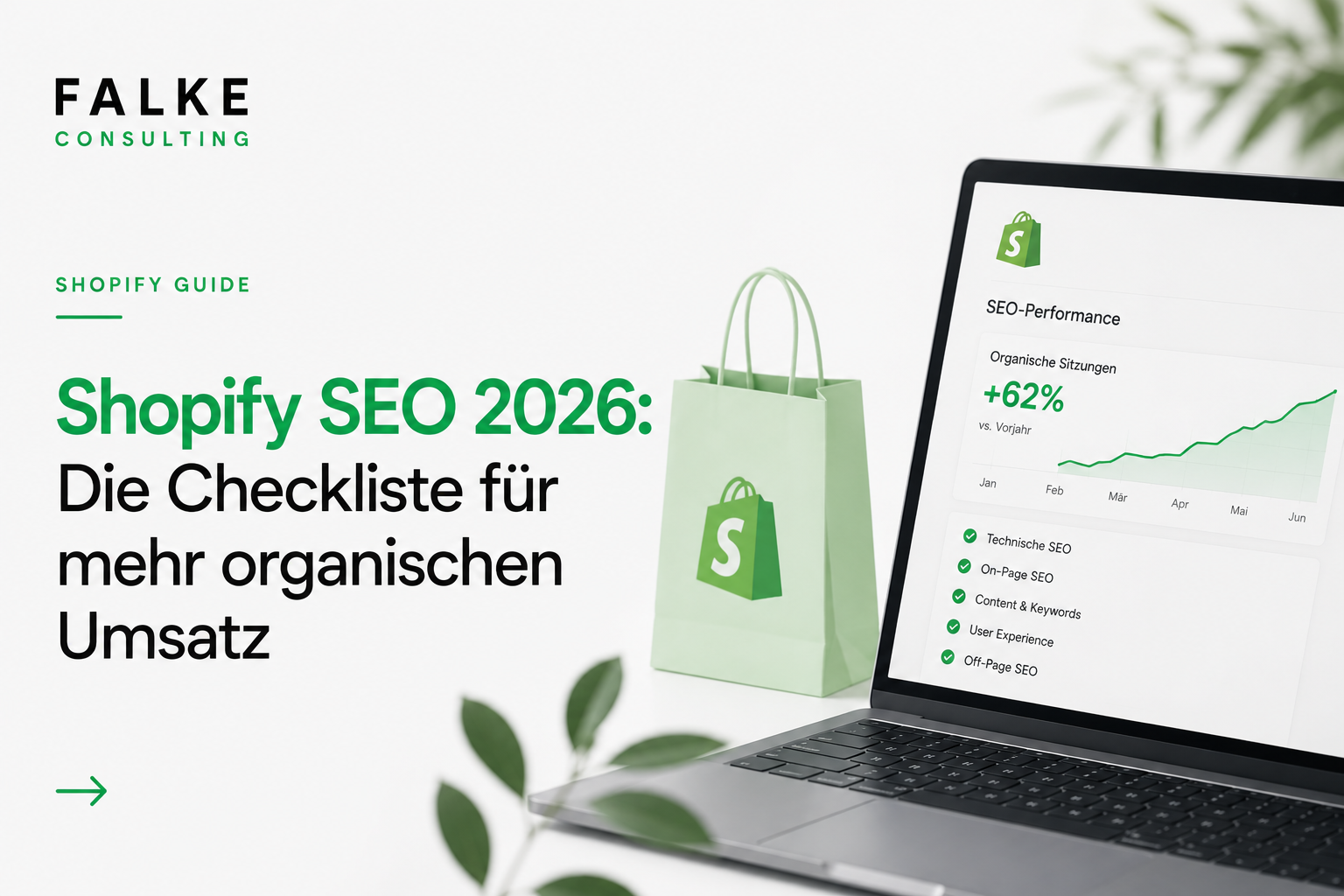
Shopify SEO 2026: The Checklist for More Organic Revenue
The battle-tested Shopify SEO checklist for growing DACH brands: technical foundations, site structure, product pages, content with purchase intent, and Core Web Vitals.

The Most Important Things in Brief
- Shopify SEO determines whether your shop is found organically – or permanently burns through advertising budget.
- The basics are clean technology, clear site structure, and fast loading times (Core Web Vitals).
- Product pages with unique texts, schema markup, and genuine search intent rank best.
- SEO is not a one-time project: initial effects usually show after 4–8 weeks, sustainable rankings after 3–6 months.
SEO determines whether your Shopify store is found on Google – or if you have to expensively acquire every visitor through advertising. This checklist will help you make structured progress in 2026: from the technical foundation to the site structure and content with genuine purchase intent.
01Why SEO determines your Shopify revenue
Organic traffic is the most sustainable growth channel in e-commerce: once you rank well, you get visitors day after day without increasing cost per click. Paid ads deliver immediately but dry up as soon as the budget ends – I delve deeper into this trade-off in the article SEO vs. SEA for Shopify. A solid SEO foundation is therefore not a nice-to-have, but the basis for predictable growth – especially for brands in the DACH region with a manageable advertising budget.
02The Technical Foundation
Before content can work, the technology must be right. Google needs to be able to crawl and index your shop cleanly. This includes speaking URLs, a correct sitemap, clean canonicals, and a well-thought-out robots.txt.
- Speaking, short URL handles instead of cryptic parameters
- An up-to-date XML sitemap in Google Search Console
- Correct canonical tags against duplicate content
- 301 redirects for old or changed URLs
- A fast, indexable theme without render-blockers
03Site Structure & Internal Linking
A logical hierarchy helps both users and search engines: Homepage → Categories → Products. Link thematically related pages internally so that link power flows and no content is left orphaned. Category and collection pages are often the underestimated SEO winners because they target high-revenue, generic search terms.
Unsure where your shop is leaving SEO potential? Book an appointment →
04Product Pages with Purchase Intent
Product pages are your most important landing pages. They need unique titles and meta descriptions, structured data (Product Schema for Rich Snippets), real images with descriptive ALT texts, and content that answers pre-purchase questions. Copied manufacturer texts rarely rank – unique, useful content does. The article Optimizing Product Pages shows you how to systematically strengthen them.
| Element | Why it matters |
|---|---|
| Unique Meta Titles | Higher click-through rate in search results |
| Product Schema | Stars, price & availability as Rich Snippet |
| ALT Texts | Image SEO & accessibility |
| FAQ Section | Answers purchase questions, wins long-tail rankings |
05Content with Search Intent
Write for specific search queries with purchase intent instead of generic keywords. A guide that solves a real problem and specifically links to suitable products attracts qualified traffic and sells. This is exactly what a well-maintained blog like this is for: topics related to your products that users are actively searching for.
06Core Web Vitals & Performance
Loading time, layout stability (CLS), and interactivity (INP) are ranking factors – and directly increase conversion. Optimize images, reduce apps and scripts, and load critical CSS first. A fast shop is displayed more frequently and converts visitors better. How to approach this specifically is described in the article Core Web Vitals & Speed. Performance and SEO are inextricably linked.
Frequently Asked Questions
How long does it take for Shopify SEO to work?
Is Shopify even suitable for SEO?
Do I need an SEO app?
How important are Core Web Vitals for ranking?
Should I run a blog for SEO?
What does professional Shopify SEO cost?
Agency, freelancer or do it yourself?

Seit Jahren setze ich Shopify-Shops für Marken im DACH-Raum um — von der Migration über den Relaunch bis zur Conversion-Optimierung. In diesem Blog teile ich, was in echten Projekten funktioniert.

Mehr aus deinem Shopify-Shop holen?
Lass uns in einem kostenlosen Erstgespräch herausfinden, wo bei dir der größte Hebel liegt — technisch, inhaltlich oder bei der Conversion.
Kostenloses Erstgespräch buchen